The Hybrid Workforce: Outsourcing

Kenny@Maru
The Evolution of Sub-contracting: Embracing the Outsourced Professional
While outsourcing is born from the roots of sub-contracting, it is vital to recognise that they are not exactly the same thing. Outsourcing represents a massive expansion in scope—a modern solution specifically engineered for a virtual world.
Here is a data-driven look at how this evolution provides unprecedented financial, operational, and HR benefits by allowing you to buy task execution without the burden of traditional employment.
1. More Than Just Sub-contracting: A Shift in Scope and Responsibility
While traditional sub-contracting gives you "on tap" labour for physical tasks, digital outsourcing scales this concept globally and across every knowledge sector. The most profound difference lies in the nature of the entity you are hiring.
When you outsource, you are engaging a business in its own right. You gain all the traditional financial benefits of on-demand expertise, but the scope is much larger. Because the outsourced entity is an independent business, they carry the responsibility for their own employees' welfare, payroll, and benefits.
This shifts your organisational responsibility. Instead of managing the day-to-day welfare of these workers, your primary duty becomes one of ethical alignment: ensuring that you outsource to a responsible business whose treatment of its employees complies with your own company's values and policies. It is a modernised, B2B approach to human capital.
2. The Financial Benefits: High-Level Execution Without the Overhead
Purchasing a resource that completes a task without requiring you to handle PAYE, National Insurance contributions, or a physical desk provides immediate bottom-line relief. The cost savings of this modern approach are significant:
- Reductions in Operating Costs: Recent industry data shows that organisations that outsource one or more of their operations can save between 20% to 40% compared to maintaining fully in-house teams.
- The Primary Driver: Up to 57% of businesses still cite cost savings as their primary motivation for outsourcing, as it converts fixed labour costs into variable, project-based expenses.
- HR Cost Optimisation: Engaging an external HR or administrative provider can save organisations a substantial amount on employment costs alone, as they avoid the expenses of recruitment, onboarding, and benefits administration.
By treating knowledge work as a sub-contracted service, you pay strictly for the value and deliverables produced, not the idle time or overhead of a traditional employee.
3. The Operational Benefits: Speed, Expertise, and Focus
Outsourced professionals plug directly into your digital ecosystem, utilising their own specialised tools to enhance speed and deliver expert results. This operational agility is crucial in a fast-paced virtual world.
- Reclaiming Time: Statistics show that approximately 45% of small business owners spend roughly one full day per week on administrative and operational HR tasks. Outsourcing reclaims this time, allowing leaders to focus on core revenue-generating activities.
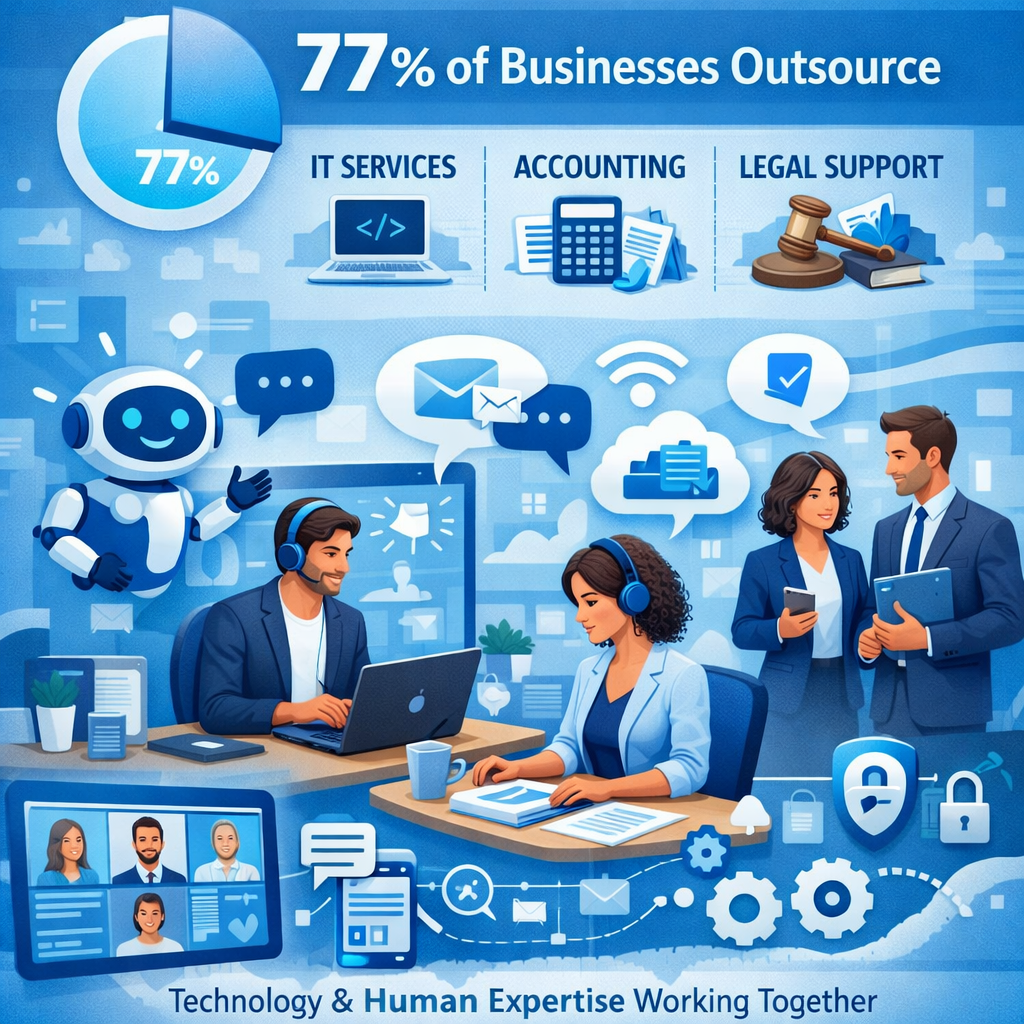
- Access to Elite Capabilities: Sub-contracting knowledge work isn't just about saving money; it's about upgrading skills. Today, 77% of businesses outsource IT functions, and 64% outsource legal tasks, specifically to access specialised, high-tier expertise they cannot easily cultivate internally.
- Plugging the Expertise Gap: Around 42% of companies explicitly state that they outsource to access skilled talent that is otherwise unavailable in their local talent pools.
4. The HR Benefits: Bypassing the Employment Burden
Perhaps the most liberating aspect of the outsourced professional is the relief it provides to your internal Human Resources department. When you buy a task-based resource rather than hiring an employee, the traditional HR burdens vanish.
- Zero Retention and Welfare Overhead: The outsourced entity is responsible for the welfare, training, and retention of its staff. Your internal team does not need to worry about the virtual CFO's career trajectory or the virtual assistant's healthcare package.
- Combating Burnout: With 80% of companies now utilising some form of HR outsourcing, internal teams are freed from the crushing weight of administrative paperwork. This allows in-house HR to focus on the culture and development of your core employees.
- Agility in Scaling: You can scale your "virtual employees" up or down based on seasonal demands without facing the difficult process of redundancies or the sluggish process of hiring.
Conclusion: A Modern Solution for a Virtual World
The shift from traditional physical sub-contracting to digital outsourcing is a testament to the adaptability of modern business. By treating knowledge workers as external, integrated business partners, you unlock the ultimate "on tap" workforce. You reap the financial rewards of reduced overhead, the operational benefits of global expertise, and the HR relief of offloading employment responsibilities.
However, with this evolution comes a new standard of corporate responsibility. Because the outsourced entity handles its own employee welfare, your job is to vet your partners rigorously. By choosing partners whose ethics mirror your own, you create a sustainable, scalable, and highly efficient digital ecosystem—the perfect modern solution for a virtual world.